Introduction
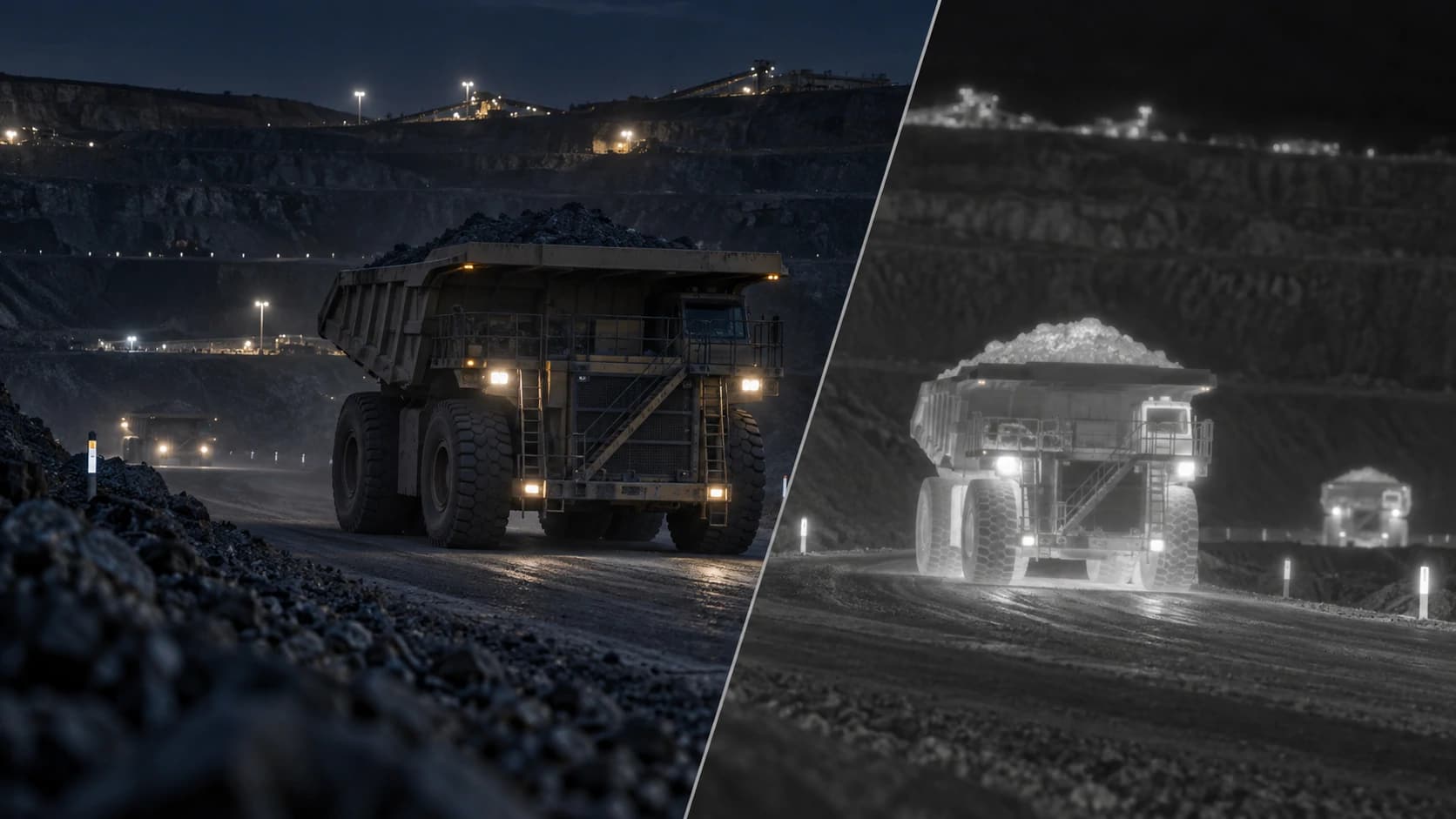
Driving at night or in low visibility can be risky for any driver. Darkness, fog and rain can make it difficult to assess the speed and distance of other vehicles or react to unexpected obstructions. In these situations, drivers cannot rely only on mirrors or regular cameras because visible-light images may miss important details.
Thermal imaging is designed for these environments. Once used mainly in military and aerospace applications, infrared detection has become increasingly relevant for vehicle safety. By tracking heat, thermal imaging cameras can help identify pedestrians, animals, moving vehicles and other heat-emitting objects that may be difficult for regular sensors to see.
This article explains how thermal imaging cameras support vehicle safety and why they are becoming an important direction for commercial vehicle visibility systems.
The Evolution of Visual Perception: Shifting to a Thermal Image Standard
Vehicle safety has moved from direct human vision toward machine-assisted perception. Drivers once depended almost entirely on headlights, mirrors and their own ability to react. Over time, cameras, radar, LiDAR, infrared imaging and driver assistance systems changed how vehicles perceive the road.
The shift has been gradual, but the direction is clear: safety systems now need to support drivers when visibility is poor, reaction time is limited and hazards may appear outside the visible spectrum.
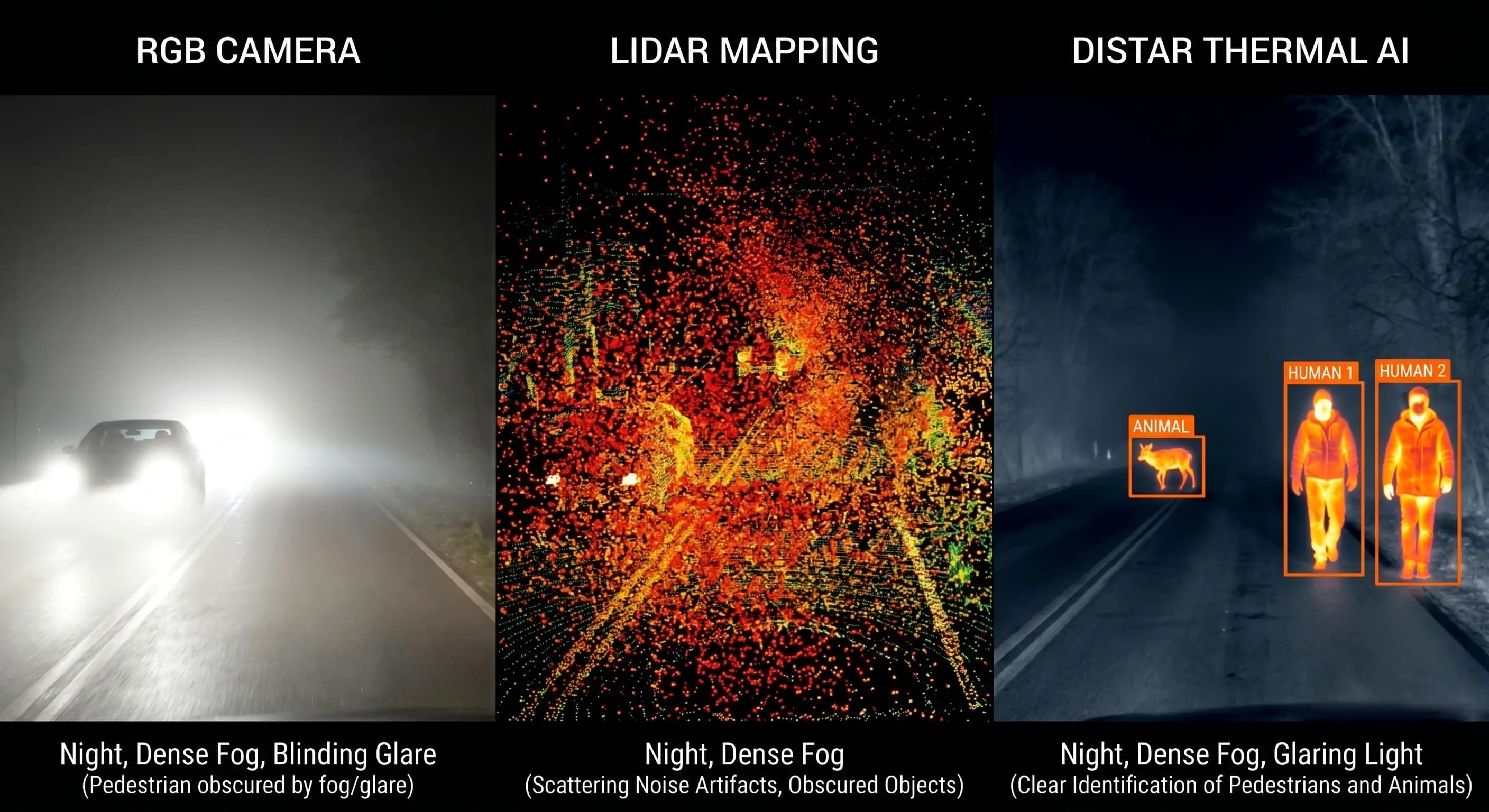
| Environmental Challenge | Traditional RGB Cameras | ADAS LiDAR Systems | Distar Thermal AI System |
|---|---|---|---|
| Total darkness | Fails without headlights or other visible light | Works through active laser ranging | Uses infrared radiation instead of visible light |
| Oncoming glare | Can be saturated or blinded by strong light | Unaffected by visible glare | Filters visible light and reads heat signatures |
| Dense fog and heavy dust | Visibility can drop sharply | Signal scattering may affect performance | Long-wave infrared can improve penetration |
| Biological body detection | Depends on pixel patterns and visible contrast | Detects outline and range | Reads high-contrast thermal signatures |
The era of human vision
Before advanced driver assistance became common, vehicle safety depended heavily on the driver's visual perception. At night or in fog, drivers had limited time to react, especially when objects were outside the range of headlights or hidden in blind spots.
Limited peripheral vision, delayed adaptation and the inability to detect thermal differences made low-visibility driving more difficult.
From traditional visibility to intelligent detection
In the early 21st century, backup cameras, dash cameras and other digital driver assistance tools became more common. These systems helped drivers see and record the road, but many still depended on visible light and driver attention.
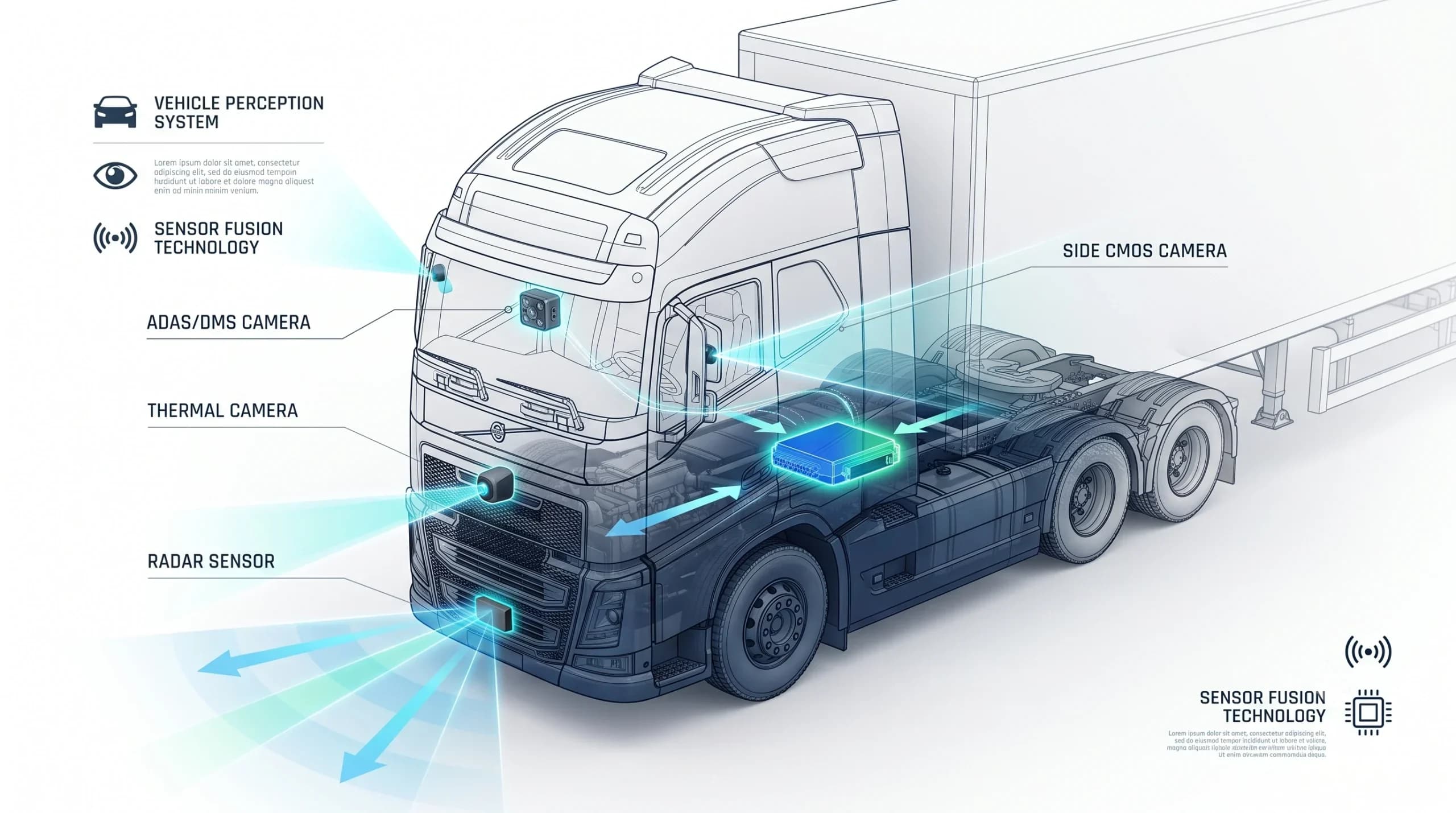
The next step was machine perception, where cameras, radar, LiDAR and thermal infrared systems work together to detect objects, estimate distance and support safer driving decisions.
Detection outside the visible spectrum
Modern thermal imaging systems do not depend on light. They read heat signatures, helping drivers detect pedestrians, animals and vehicles in darkness, fog or glare.
This makes thermal imaging a useful complement to cameras, radar and other safety systems rather than a simple replacement for them.
The Limitations of Traditional Cameras
Dashcams, rear-view cameras and 360-degree camera systems can improve vehicle awareness, but visible-light cameras have important limits in difficult environments.
- Traditional cameras require visible light to perform well.
- Fog, glare, dust, smoke and heavy rain can reduce image clarity.
- Hidden threats may remain difficult to identify until they are close to the vehicle.
- Animals, pedestrians and roadside obstacles can be missed when contrast is low.
Beyond Standard ADAS: Why Thermal Imaging Matters in Bad Weather
ADAS and LiDAR technologies can support driver assistance, but poor visibility can still affect sensor performance. LiDAR can work in darkness because it emits laser pulses, yet dense fog, heavy rain and airborne dust may degrade signals. Visible-light cameras can also be affected by sensor data quality in poor conditions.
Thermal imaging works differently. It identifies heat signatures and can maintain useful detection capability in environments where visible-light cameras struggle. This gives fleet operators another layer of perception for night driving, adverse weather and complex road conditions.
Independent Perception: Thermal Signatures and Surface Temperature Variations
Standard automotive cameras perform best in natural sunlight or supported lighting. Thermal imaging changes this by operating independently of ambient visible light. It detects infrared radiation emitted as heat and translates heat differentials into a digital image.
Humans, animals, vehicles and machinery all produce different thermal patterns. A thermal camera can recognize those heat patterns even when headlights, reflections or low contrast make visible-light images difficult to interpret.
This can give drivers more time to react when a pedestrian, animal or other obstacle appears in a dark or low-visibility environment.
Environmental penetration
Thermal imaging can help in environments where visible-light cameras often struggle, including rain, fog, snow, glare, dust and smoke. Because it reads heat instead of reflected visible light, it is less affected by some lighting and reflection problems.
This is useful for highways, construction zones, off-road routes and urban roads where wet surfaces, bright headlights or airborne particles can reduce visibility.
Long-range awareness
The source article notes that thermal imaging can extend the driver's detection horizon by identifying heat-emitting objects beyond what headlights may reveal. Exact detection distance depends on the selected camera, lens, installation position, weather conditions and system configuration.
For fleet projects, the practical value is earlier awareness: drivers and monitoring systems can review hazards sooner and make decisions with more context.
Industrial and Commercial Applications of Thermal Imaging
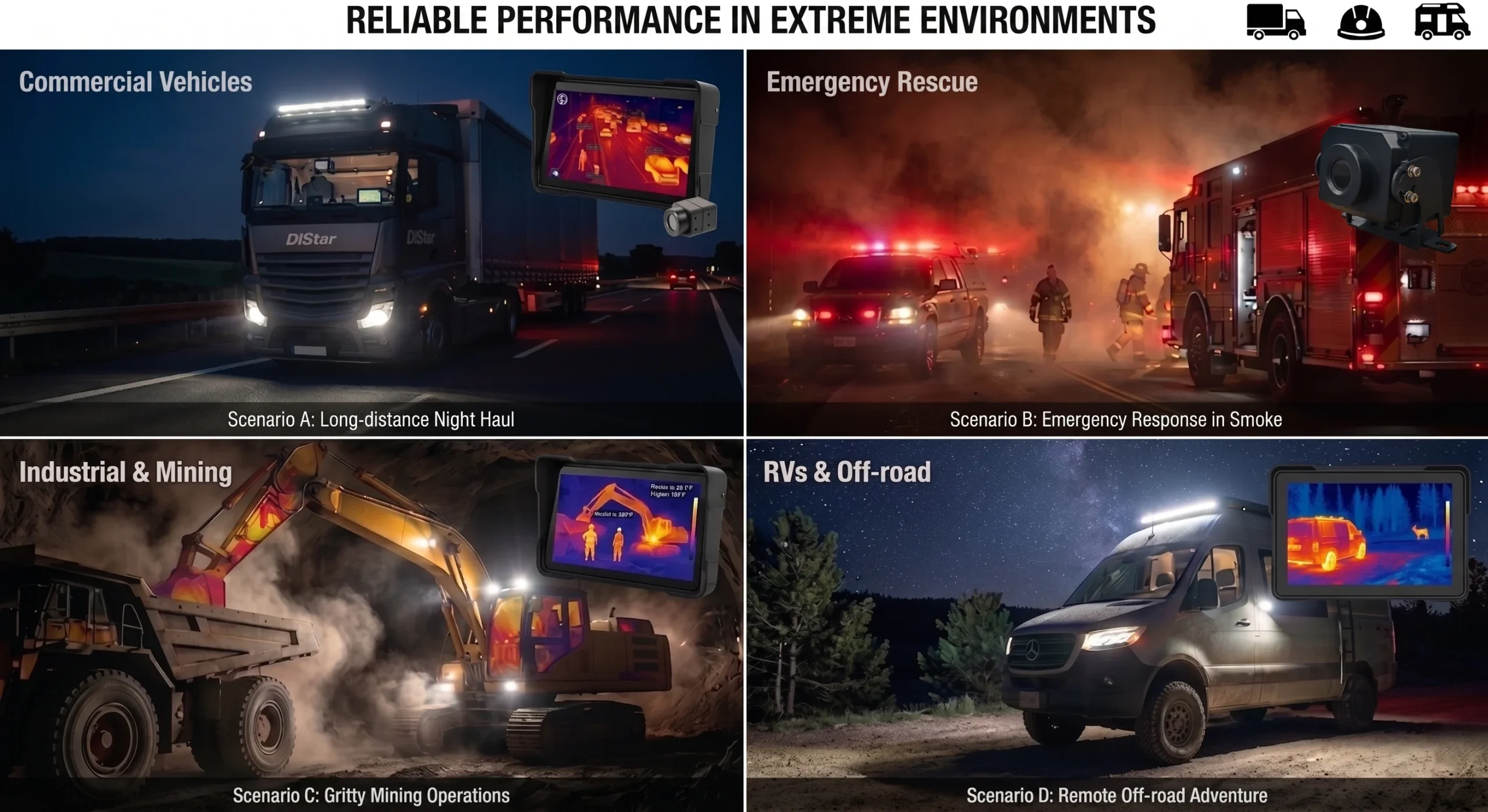
Thermal imaging was once used mainly in military, scientific and specialized industrial contexts. Today it is also relevant for commercial vehicles, special vehicles and fleet safety applications.
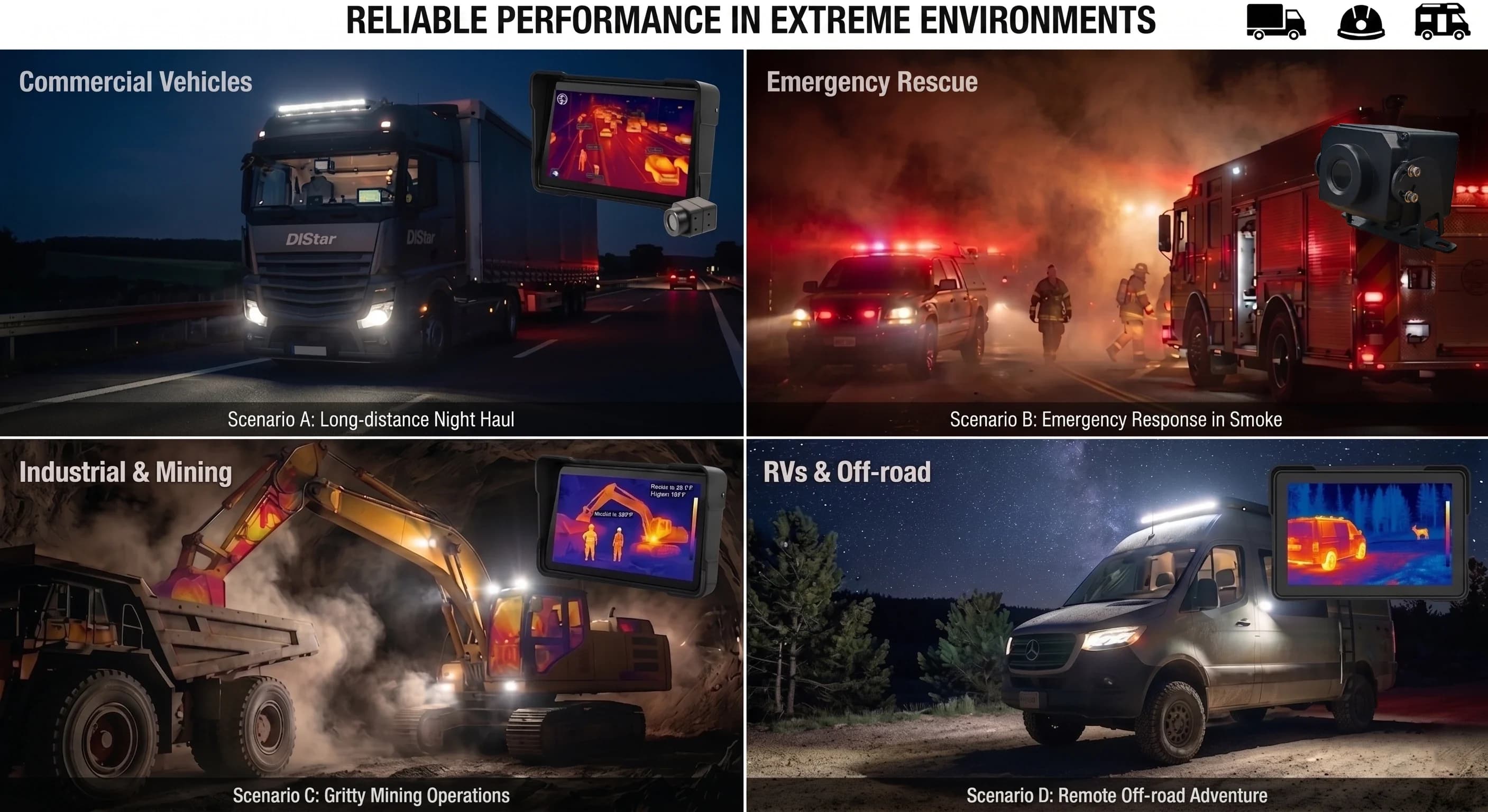
Commercial vehicle fleets
Long-haul transportation often involves night driving, bad weather and sudden animal crossings. Thermal imaging cameras can support drivers by detecting heat-emitting objects in low light and showing hazards earlier than visible-light systems alone.
- Detecting objects in low-light conditions
- Supporting AI-assisted alerts when the selected system includes this function
- Improving visibility where headlights and standard cameras struggle
- Helping drivers review potential risks earlier
Emergency rescue and special operations
Thermal imaging can also support specialized vehicles used in emergency rescue, firefighting and other operations where smoke, darkness or fast response requirements make visibility critical.
Industrial and mining environments
Industrial sites and mining environments often involve darkness, dust, tunnels, heavy equipment and abnormal heat patterns. Thermal imaging can help operators detect nearby workers, machines and overheating components when conventional vision is limited.
RVs and off-road travel
Recreational and off-road vehicles may operate on unpredictable terrain with limited lighting. Thermal imaging can help identify hidden obstacles, wildlife and pedestrians that are difficult to see at night.
Platform Integration: From Standalone Thermal Camera to Unified Imaging System
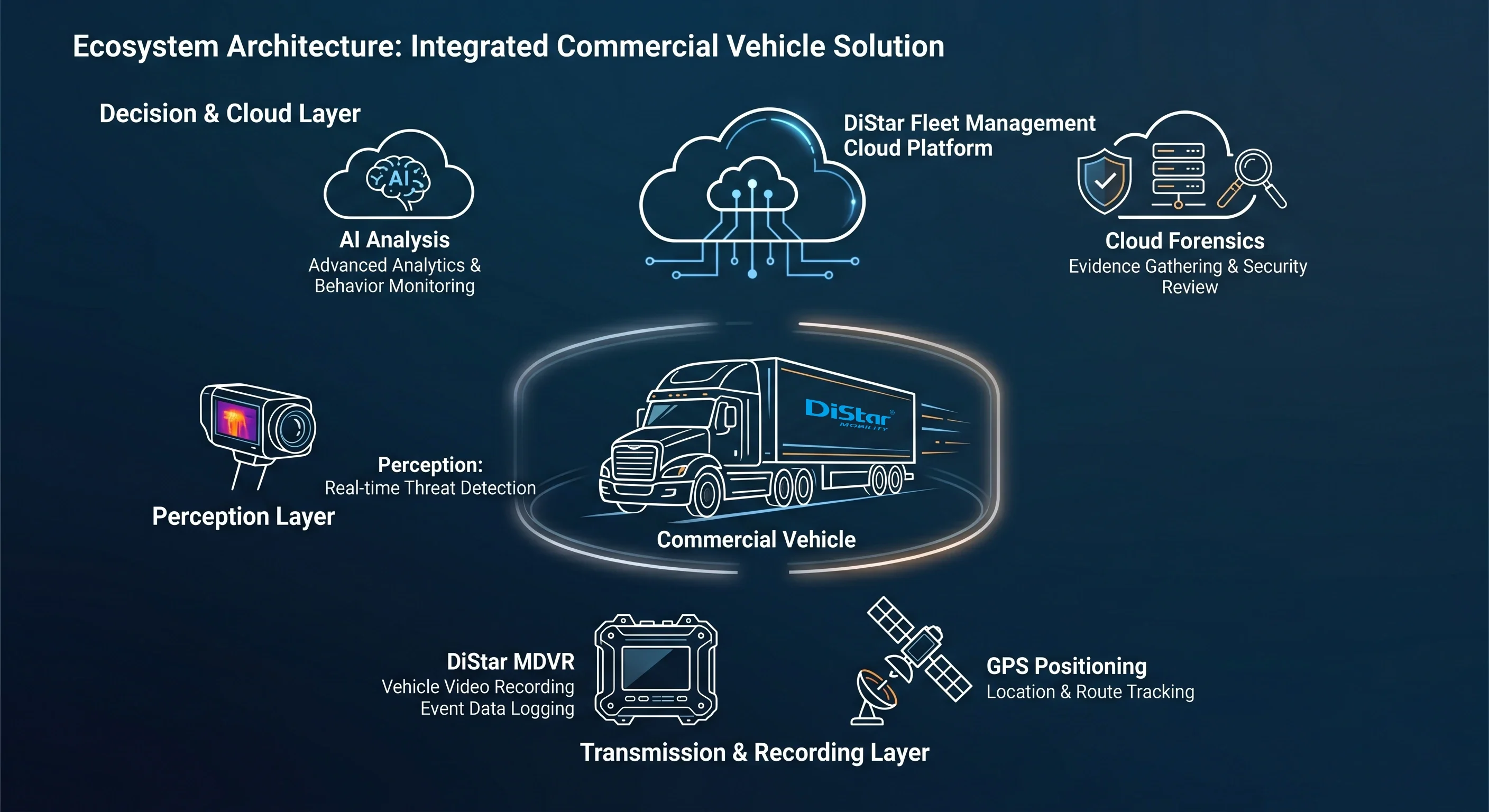
A modern thermal imaging camera is not only a standalone visibility device. In commercial vehicle projects, it may be integrated with GPS, MDVR, AI detection and cloud-based monitoring workflows.
When thermal sensing is connected with vehicle positioning, recording and platform review, drivers and fleet managers can observe, track, record and evaluate events through a more complete system.
Integration with GPS and MDVR platforms
GPS supports real-time positioning, while MDVR systems manage video recording and storage. When combined with thermal imaging, the system can detect risks, record evidence and support later review.
This type of integration is especially relevant for fleet projects where visibility, vehicle tracking and incident evidence need to work together.
AI-assisted thermal data
AI-assisted thermal imaging can classify heat sources, distinguish different object types and reduce false alarms when the selected system supports these functions. Thermal patterns may help the system interpret pedestrians, animals, machinery, exhaust heat and environmental heat sources.
Closed-loop thermal imaging platform
The integration of thermal AI, GPS, MDVR and fleet platforms reflects a shift from single hardware purchases toward closed-loop safety systems. The goal is to connect perception, tracking, recording and decision support.
Business Value of Upgrading to Infrared Technology
Thermal imaging is often discussed from a safety and visibility perspective, but the business value can also matter for fleet operators. When connected with GPS, MDVR, AI and cloud workflows, thermal imaging becomes part of an operational safety system.
Cost reduction
Accidents, emergency repairs and insurance disputes can create significant costs for trucking companies and fleet operators. Thermal imaging can support earlier hazard detection and help reduce risk when used as part of a broader safety strategy.
Brand value and trust
Safety investment can influence how customers, partners and drivers view a mobility business. Deploying advanced visibility and driver assistance systems can help demonstrate a stronger safety culture.
Compliance and Evidence Review
Fleet operators often need driving records, event evidence and reviewable vehicle operation data. Integrated thermal imaging, recording and platform workflows can support incident investigation and operational review.
Moving Toward Safer Fleet Operation with Thermal Imaging
The transportation industry continues to focus on reducing accidents and improving driver awareness. Thermal imaging can help by supporting earlier risk perception in darkness, dust, fog and other complex environments.
For autonomous driving and driver assistance systems, thermal imaging can complement AI, GPS tracking and MDVR platforms by adding heat-based perception to the overall safety stack.
Final Words
Thermal imaging has become an important part of vehicle safety discussions. It can improve visibility, help detect hazards earlier and support driver-assistance workflows in environments where traditional cameras may be limited.
For commercial vehicles, RVs, emergency vehicles and passenger mobility applications, the practical question is not only whether a thermal camera can see in the dark. It is whether the camera, alert logic, recording workflow and platform integration can operate as one useful safety system.