Introduction
Selecting a thermal imaging system for a mining haul truck is not simply a matter of comparing camera resolution or detection distance.
A system that produces a useful image on one vehicle may perform very differently when mounted on another truck, operated on a different haul road or connected to a different in-cab display. Vehicle geometry, mounting height, dust, vibration, temperature contrast, display position and driver workflow all affect the final result.
The first purchasing question should therefore not be, "Which thermal camera has the longest range?" A better question is: what visibility problem must the system help the operator assess, and under what operating conditions?
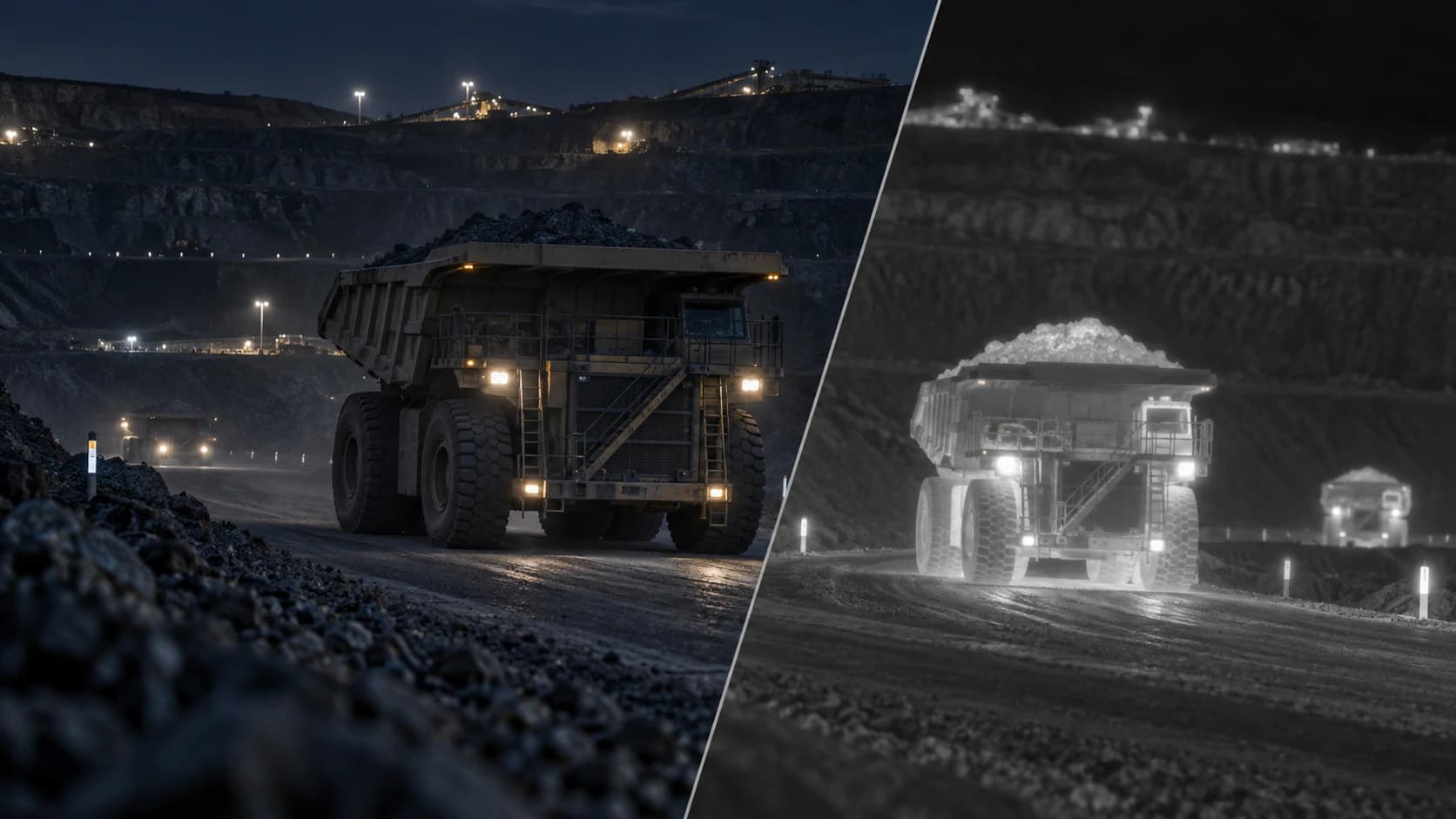
Thermal imaging can provide useful visual contrast in darkness and selected low-visibility conditions because it responds to differences in emitted infrared energy rather than depending only on visible light. However, it remains an auxiliary visibility technology. It does not replace mirrors, traffic controls, operator training, radio communication or established mine-site procedures.
This guide explains how mining operators, vehicle manufacturers and system integrators can define requirements and compare thermal imaging solutions for haul trucks and other heavy mobile equipment.
Why Visibility Planning Matters for Mining Haul Trucks
Large mining vehicles create visibility challenges that are different from those of highway trucks. The operator may sit several metres above ground level. The body, engine compartment, tyres and loading structure can obstruct nearby areas. Smaller vehicles or personnel may be difficult to see when positioned close to the machine.
The U.S. Mine Safety and Health Administration discusses powered haulage risk and notes that surface mining vehicles can be large enough for smaller vehicles to be difficult for the operator to see. Its guidance emphasizes training, communication and traffic controls, while noting that warning and avoidance technologies can provide additional support. MSHA powered haulage safety materials should be treated as industry safety background, not as an endorsement of any supplier or product.
ISO 5006:2017 provides a static method for evaluating the operator's field of view on earth-moving machinery. A thermal camera does not automatically make a vehicle compliant with this standard, but the standard illustrates why visibility should be evaluated around the whole machine rather than treated as a single forward-view problem.
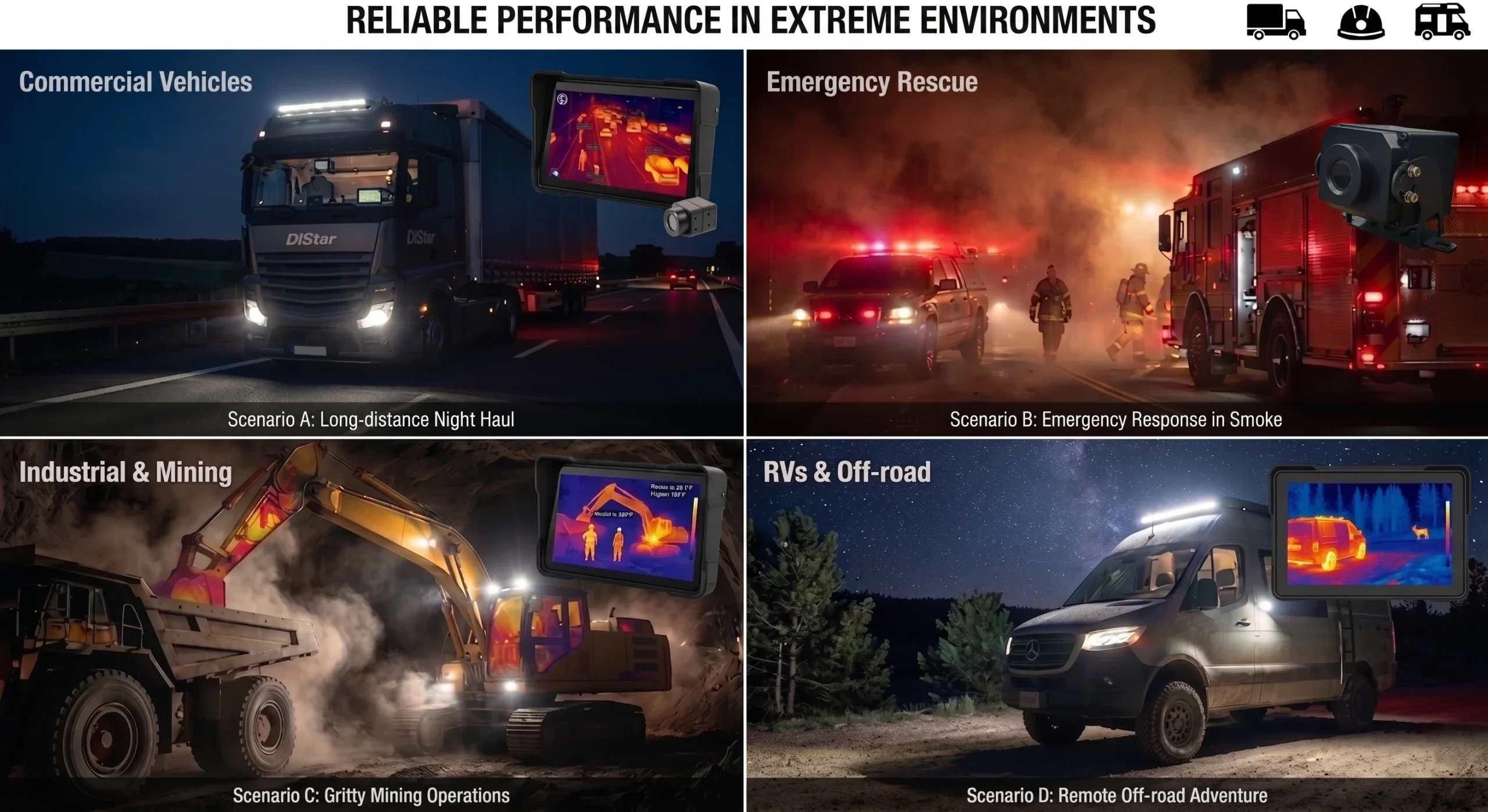
Typical mining visibility conditions include night operation on haul roads, strong contrast between illuminated and shadowed areas, dust generated by vehicle movement or loading, large blind-zone areas near the vehicle body, personnel and light vehicles near heavy equipment, dirty lenses, continuous vibration and significant changes in ambient and target temperature.
Before selecting equipment, the project team should document which of these conditions applies and where the operator needs additional visual information. Distar's mining vehicle visibility solutions page can help frame the application direction before hardware is selected.
Step 1: Define the Operational Scenario
A useful requirement begins with the vehicle and workflow. Record the vehicle type, model, dimensions and operating environment. A rigid haul truck, articulated dump truck, wheel loader and excavator do not have the same geometry or driver sightlines.
The project team should confirm whether the main need is forward visibility, reversing visibility or near-field side coverage; whether the vehicle operates mainly at night, during shift changes or continuously; whether personnel or light vehicles are regularly present nearby; and whether the vehicle is used on open haul roads, at loading points or inside restricted areas.
The team should also decide whether the operator needs a continuous image or event-based alerts, whether the system is intended for the driver, a remote supervisor or both, whether thermal video must be recorded by an MDVR, whether the vehicle already has a display that can accept another video input and whether AI-assisted pedestrian or vehicle alerts are required.
These answers determine the architecture more effectively than a specification sheet alone.
Step 2: Choose the Required Coverage
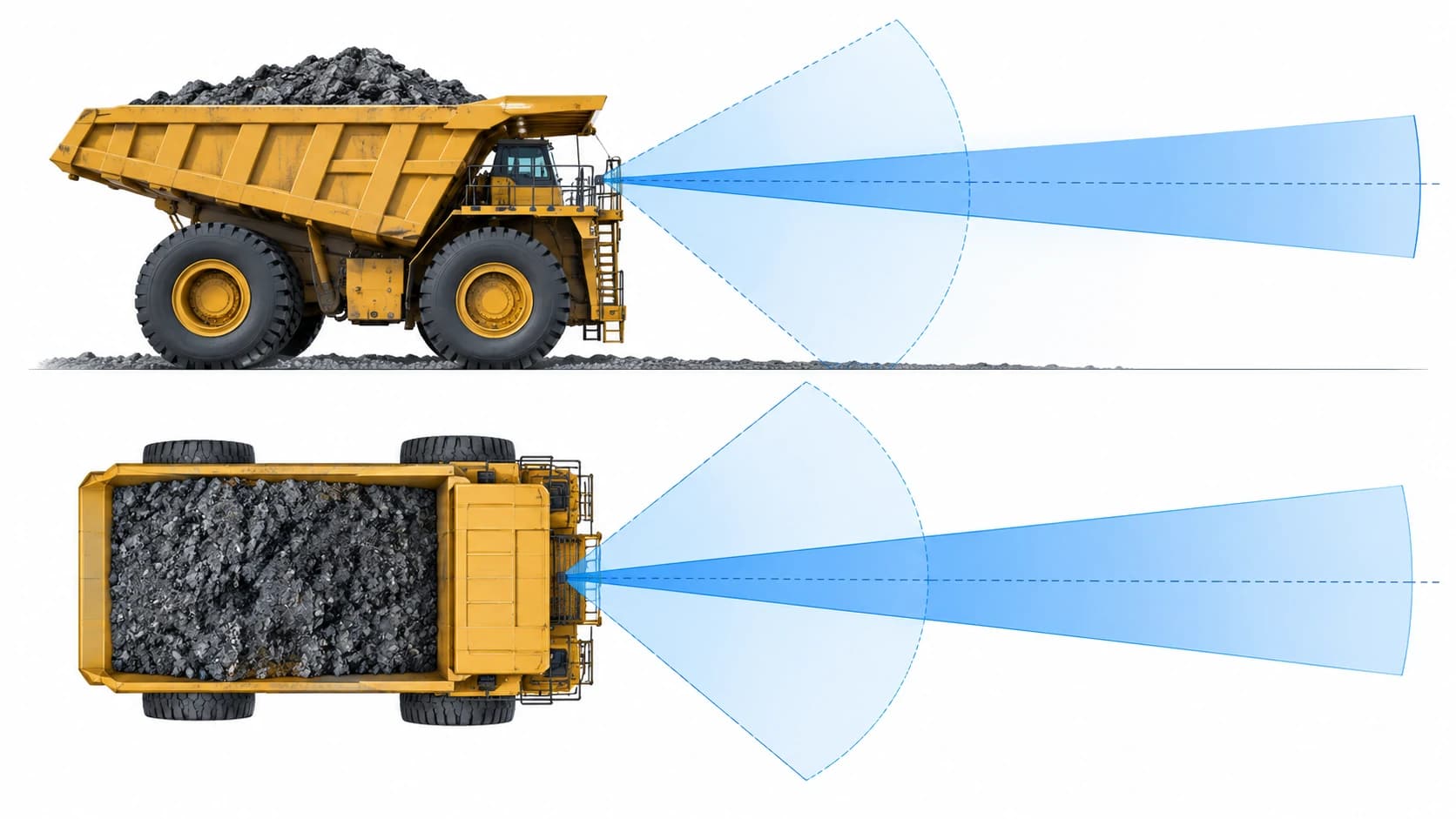
Coverage planning should start with the part of the work cycle that needs support. A narrower field of view can place more image detail on distant objects, but it covers less area close to the vehicle. This may suit a forward-facing camera intended to support earlier assessment along a haul road.
For example, Distar Mobility's DST-C3 thermal imaging camera series includes a 384 x 288 thermal detector and a listed 9.1 mm lens option with a 29° x 22° field of view. Whether that configuration is appropriate depends on mounting height, road geometry and the assessment task.
A published catalogue distance must not be treated as a guaranteed site result. Performance can change with target size and orientation, temperature contrast, lens choice, weather and airborne material, installation height and angle, display size and resolution and algorithm settings when AI is included.
Near-field coverage normally needs a wider field of view. The objective is not maximum distance but useful coverage beside, behind or immediately in front of the machine. A wide-angle thermal view may reveal a larger area, but distant targets occupy fewer pixels. Project teams must therefore balance coverage and detail rather than assuming that wider is always better.
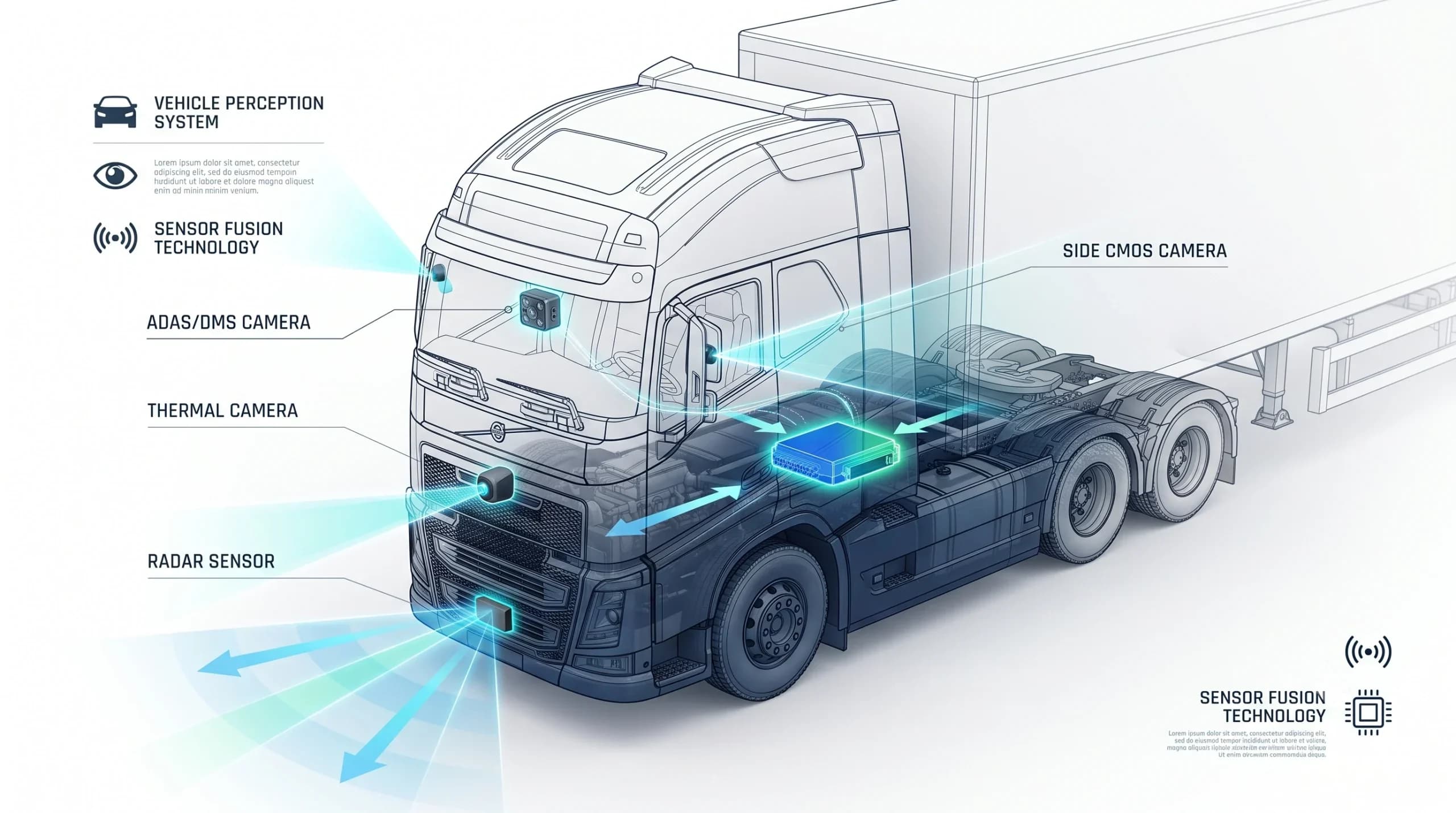
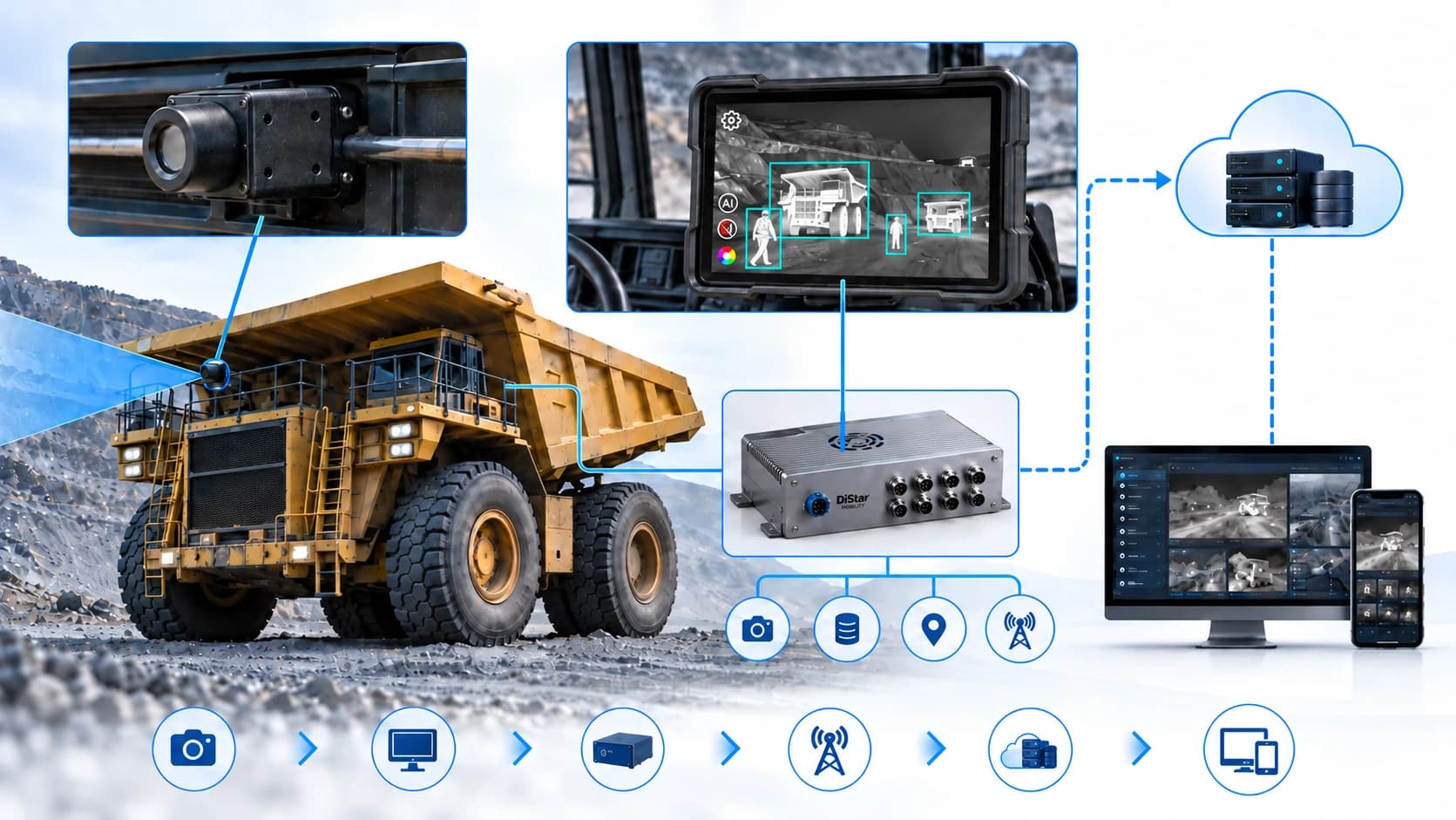
One camera rarely addresses every visibility gap on a large mining vehicle. A system may combine a forward thermal camera, side or rear visible-light cameras, a reversing camera, a surround-view system, radar or proximity information, an in-cab display, MDVR recording and remote review. The correct combination depends on the risk assessment and operating workflow.
Step 3: Evaluate Thermal Resolution and Lens Options
Thermal resolution affects the level of spatial detail available to the operator or detection algorithm. Common project options may include 256 x 192, 384 x 288 and 640 x 512. Higher resolution can provide more image detail, but it also affects cost, processing requirements and system bandwidth.
Resolution should never be evaluated separately from the lens. Two cameras with the same detector can produce very different coverage when fitted with different focal lengths.
The project should compare horizontal and vertical field of view, expected object size in the image, near-field coverage, required assessment distance, camera mounting height, display resolution and AI processing requirements.
A supplier should be able to explain why a particular detector-and-lens combination fits the vehicle rather than recommending the highest specification by default.
Step 4: Decide Whether AI Detection Is Required
A thermal image and an AI thermal detection system are not the same product. A basic camera produces thermal video for the operator to interpret. An AI-enabled system may classify defined object types and generate warnings, depending on its trained models and configuration.
Distar Mobility's DST-UNV universal thermal imaging main unit is designed to add AI-assisted pedestrian and vehicle recognition to compatible onboard systems and provides CVBS and USB outputs. Such capabilities must be evaluated at system level.
The review should include supported object classes, minimum useful target size, alert zones, warning logic, vehicle speed and operating mode, false or nuisance alarm management, display and speaker behavior and data communication with other devices.
Do not assume that every thermal camera supports AI simply because it produces a clear thermal image.
Step 5: Confirm Display and Recording Integration
The value of a camera depends on whether the information reaches the right user at the right time. In the cab, confirm available video inputs, supported video format, screen size and resolution, display switching logic, trigger inputs, placement within the operator's sightline and whether the thermal view is continuous or event-triggered.
Adding a second monitor may be acceptable on some vehicles but undesirable in a crowded cab. A vehicle-specific decoder may allow thermal images to use an existing factory display. This can reduce additional hardware, but compatibility must be checked for each vehicle platform.
If the project requires event review, confirm whether the MDVR can record the thermal video format, preserve the intended image quality, associate video with time, GPS or vehicle status, retrieve clips remotely, display thermal and visible channels together and export evidence in a usable format.
Live driver visibility and remote fleet review are related but separate requirements. Both must be specified.
Step 6: Check Environmental and Mechanical Suitability
Mining installations expose electronics to conditions that may not appear during a short desktop demonstration.
Review ingress-protection rating, operating-temperature range, vibration and shock documentation, connector design, cable sealing, mounting-bracket strength, corrosion considerations, lens-window material, defrosting or heating support and cleaning and maintenance access.
An IP rating does not prove suitability for every mine site. It must be considered alongside installation quality, connector sealing and maintenance practice.
Step 7: Plan Power and Vehicle Integration
Mining vehicles may have 12 V, 24 V or other electrical architectures. Voltage variation, starting events, load switching and grounding can affect video equipment.
The installation plan should confirm nominal and operating voltage range, protection against reverse polarity and transients, fuse location, grounding method, cable routing, ignition or wake-up control, power consumption and compatibility with the display, recorder and control unit.
Power and signal cables should be planned before the shipment is released, not improvised when the vehicle arrives at the installation site.
Step 8: Require a Relevant Factory Acceptance Test
A meaningful factory test should reproduce the intended system configuration as closely as practical. This is a recommended procurement and shipment-readiness process, not a claim that a specific customer project has already completed the same test.
The test should confirm correct camera model and lens, thermal video output, display compatibility, MDVR recording if required, trigger or switching behavior, AI alerts if included, cable and connector configuration, device labeling, requested firmware or parameters and quantity and accessory inspection.
A factory acceptance test does not replace commissioning on the vehicle. It reduces avoidable integration problems before shipment.
Step 9: Commission the System on the Actual Vehicle
Final evaluation should take place on the installed vehicle. This is also a recommended process rather than a statement about any completed Distar mining deployment.
A practical commissioning process includes confirming that the camera is mechanically secure, inspecting cable routing and connector sealing, verifying the field of view with the vehicle stationary, checking target visibility at relevant distances, testing during representative day and night conditions, evaluating glare, dust and temperature-contrast conditions, checking the operator's ability to interpret the display, verifying alerts without creating excessive nuisance warnings, confirming MDVR recording and playback and documenting the approved camera angle and configuration.
The objective is not to produce the most dramatic thermal image. It is to provide information that fits the operator's workflow.
Questions to Send a Thermal Imaging Supplier
Before requesting a quotation, prepare the vehicle type and model, vehicle dimensions, intended camera positions, photos or drawings, main operating scenario, day and night conditions, required field of view, display or factory-screen information, existing MDVR model, video interface requirements, AI detection requirements, power supply, cable-length requirements, environmental requirements, estimated project quantity and prototype or production schedule. You can also send your vehicle requirements for a project-level review.
The more specific the requirement, the more useful the supplier's recommendation will be.
FAQ
Can one thermal camera remove all mining-truck blind spots?
No. Camera coverage is limited by its mounting position and field of view. Large vehicles normally require a combination of mirrors, cameras, operating procedures and, where appropriate, other sensing technologies.
Is a higher-resolution thermal camera always better?
Not automatically. Resolution, lens, field of view, display and target distance must be evaluated together.
Can thermal imaging replace a normal camera?
In most mining-vehicle projects, thermal and visible-light cameras are complementary. Thermal imaging supports heat-based visibility, while visible cameras provide colour, signs, road markings and visual context.
Does thermal imaging work through heavy dust?
Performance depends on dust density, particle characteristics, target temperature contrast, lens condition and distance. It should not be described as universally seeing through dust.
Can thermal video be recorded by an MDVR?
Often yes, if the camera output and recorder input are compatible. Video format, channel capacity and recording quality must be confirmed.
Does every thermal camera support pedestrian detection?
No. AI recognition requires compatible processing hardware, algorithms and configuration. A standard thermal camera may provide video without object classification.
Conclusion
Choosing a thermal imaging system for a mining haul truck requires more than comparing headline specifications.
The project should begin with the vehicle geometry, operating scenario and visibility gap. Resolution and lens selection should then be matched with display, recording, AI, power, environmental and installation requirements.
Thermal imaging can add valuable information in darkness and selected low-visibility conditions, but it remains one layer within a wider mine-site safety and visibility strategy.